| Supported Audio File Formats | All |
| Supported High-Quality Audio File Formats | All |
| DSD Support | DSD256 |
| DAC | Hybrid – explained in review |
| Resolution | 384 kHz/ 24 bit PCM |
| Dynamic Range | 120dB |
| THD / Noise | <0.002% |
| 3rd-Party Integrations | ATIDAL (Connect), Qobuz (Connect), Deezer, HighResAudio, Spotify (Connect), Internet radio, Roon ready |
| Amplification | 2 x 30W into 8 ohms, 2 x 50w into 4 ohms |
| Frequency Response | 1Hz to 50kHz |
| Inputs/Outputs | 2 x digital RCA, 1 x optical, LAN, USB, wi-fi, HDMI e ARC / 1 x stereo RCA, 1 x optical |
| Dimensions | 207 (W) x 250 (D) x 62 (H) |
| Weight | 1.7kg |
Verdict
Interesting innovation in the digital domain. Translates into sonic excellence with nuance and fine detail. Amplification could be more powerful?
PRICE R44, 950.00
SUPPLIED BY Acoustic Arts Ben 083 291 1271
WEBSITE
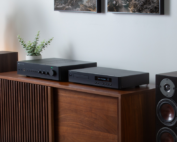
The Lindemann Woodnote Combo all in one music player is precisely what it says on the box. But this is an upmarket device and you’d be fooled into being tricked into thinking otherwise by its compact dimensions which these days appear to be becoming a standard for streamers. Personally I’d like a little more box for my bucks but that’s because I’d have this on show loud and proud in my system where it would do server service.
Before we begin setup was one of those where reading the manual helps. You need to connect it to your local wi-fi – it comes with two aerials that screw in to give it more range and bandwidth. Read the manual!
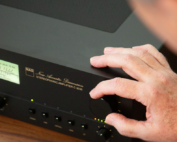
Once you have connected into your wifi however it is practically bullet proof and it never so much as looked like it was being wi-fi throttled. Speed of music playback was perfectly acceptable and if anything the Tidal interface is almost as good as Tidal itself. I only use Tidal these days and so I didn’t test any of the others. Powering on is a matter of pushing the volume knob and all the rest is driven by app or remote.
In the Combo what Lindemann are doing slightly differently to the ‘insert mass made DAC’ into a box with ‘some tweaks’ and badging it as ‘new and high end’ brigade is to engineer some actual digital finesses into their product.
Key to what they do is to grab the digital stream and convert it into DSD (direct stream digital) before decoding it. They also do volume control at this point, ahead of decoding – as you might imagine there is a degree of technicality in all of this which is summed up as follows:
- The Method: Instead of taking “snapshots” of sound thousands of times per second with large chunks of data, DSD records whether the audio wave is moving up or down at any given instant.
- The Speed: Standard DSD (DSD64) samples the audio at 2.8224 MHz—which is 64 times faster than a standard CD.
- Higher Tiers: You will also see higher-resolution variants in hi-fi stores, such as DSD128 (5.6 MHz) and DSD256 (11.2 MHz).
Hence at DSD 256 the Woodnote is running at something like 256 times faster processing than a standard CD and it is in this tracking that some claim to bring digital closer to analogue. I have my own views on this which differ somewhat but I won’t dispute what others hear in their listened experience.
What is important is that once you have the Woodnote linked into the Lindemann app on your device (make sure your wi-fi signal is decent) whatever it is that is taking place behind the scenes is irrelevant to the sonic picture being presented. The unit excels at this, punching far above it’s anticipated weight. You won’t care about the digital kerfuffle because you will be enjoying your music in other words…
I ran the unit both delivering to my monitor speakers ((Xavian Mia’s and Paradigm sub via RCA output) directly, and acting as a source for my larger setup (NAD 298 amp and Martin Logans). Let’s just get this out of the way. I see no point in adding the amplification to the Woodnote other than as a marriage of convenience because the 30W a channel into 8 ohms simply isn’t enough. I clipped the amp a little too easily because admittedly I listen to my music at reference levels which in my room takes effort given the size. That said, it’s not necessarily a criticism but a reflection on my setup which will differ to everyone else’s. The amp is Class D off the shelf which Lindemann admit (to their considerable credit) but from which they extract as much as is possible with short signal paths and, get this, Class A op amp input stage design which I think contributes to the cleanliness of music when played back with the amp.Whilst there may be few watts there the ones that are are sweet!
The design philosophy I get. It adds the Combo to the Woodward Combo and it will work for smaller environments paired with high efficiency speakers. My personal view is that I think more power and a bigger chassis is more appropriate to this approach simply because this unit has the ability to run with the big dogs. This is not a feather weight component when you start to seriously listen to it you will find that there far more substance to the streaming than you might suspect.
That all said, my initial impressions of the Woodward run in amp mode is that rather than hearing coloured warmth I got a greater sense of neutrality and given it’s wide frequency response, is in line with expectations. Un-stresssed listening is fatigue free but induces volume increases accordingly, such is the level of transparency and detail on offer. When music is as natural sounding and clean as this unit provides, it always sound less loud than it actually is (what I call the power trap that accounts for many a speaker and/or amp’s premature demise!).
What I must add is that the HDMI eARC input is a clever addition. Plug that in and some speakers and then run this setup against a sound bar on your home cinema and let me know what happens…
I thus spent more time with the unit acting as a front end and leaving the heavy lifting to external amplification to get me to the listening levels I enjoy. What was interesting was that the additional power reflects in lock step with my initial impressions and in fact clarifies the fairly neutral approach to the job that the I find NAD brings to the party to begin with. The Woodnote I was satisfied was able to present it’s neutrality through the NAD in other words and what this means is that the levels of detail and again, transparency that the DAC approach by Lindemann have used are expressed in the listened experience. It is therefore inherent and not the result of the amplification in the Woodnote and consequently it is the source function that is the heart and soul of the unit.
This is important because again, what this means is that it makes for a front end source of extremely high calibre. Treat it as such and you are well rewarded in ensuring that the rest of your system is able to exploit all that is on offer.
To be honest, I have always found it difficult to distinguish streamers apart from each other. Once you reach a certain threshold of processing power there is a finite limit to what can be done to digital bits to blunt force trauma a digital signal into an analogue pathway and laws of diminishing returns start to apply in my humble opinion. I start to hear more and more about less and less until I hear everything about nothing and it is only with time spent in front of these units that one can appreciate the subtleties in the listened experience. Once heard however, a thing cannot be unheard!

It is in layering that the Woodnote excels. All the usual placement, tone, timbre and imaging is as one would expect but it is in the ability to create depth and believable height that I found the unit to be particularly good. It is possible to recreate a listened space that is as close to the original recording as I think you’re going to easily find with the Woodnote layering the music on top of itself without muddying the image in the process. This creates a three dimensional believability to the music that elevates the performance up a notch, which at this level of reference amongst digital streamers is no mean feat.
I mentioned fatigue free listening and this is extended when using the unit as a source only. I literally listened for endless hours at a time and the app must take a bow – it is easy, simple and uncluttered by excess bumpf. I am also a big fan of the minimalist looks and easy to use remote (which I lost on two occasions down the side of my chair because I got lost in listening – it happens!). As a source the Woodnote is easily one of the best and their approach to firstly DSDing the digital signal before applying brute force decoding to analogue at extreme levels absolutely works with the sonic results I was able to pick up in the afore-mentioned layering in particular. Balance of musicality is on point of course and I particularly enjoyed the pace at which the Woodman is able to maintain, which I tend to pick up when listening as slightly forward. I enjoy music presented to me, as opposed to being extracted from a system. Show me what you got, let me listen to it and don’t be shy!
It makes the Woodnote Combo hard to fault. Yes, I would like more grunt from the in built amp (which has the right approach, but just needs more power to allow it to blossom) but I’d also like a 911. And world peace.
But for those with access to properly excellent high efficiency speakers take note. The Woodnote Combo is going to instill a performance that will easily last you an extremely long time. The dgital base is awesome and will easily undergo many upgrades around itself. I suspect that’s about the worst thing one can say about it in that it is a ‘sleeper component’ that may well draw you into the rabbit hole of upgrading your system because that’s what truly excellent sources always do. They can see you through numerous improvements because the headroom to display more and more sonic information from the source is already there.
I meant it when I said that this is a unit that will run with the big dogs!
Categories
Latest News
Apple Music Now Available on Bluesound!
Apple Music subscribers can now listen to over 100 million songs, ad-free, on Bluesound wireless speakers, stereo components, and soundbars [...]