| Operating System | Android 13 |
| Working mode | Android mode/Pure music mode/USB DAC mode/Bluetooth receiving mode |
| Bluetooth transmission (5.0) | AAC/SBC/aptX/aptX HD/LDAC/LHDC |
| Bluetooth reception (5.0) | SBC/AAC/LDAC |
| microSD card | Single microSD card expansion, theoretically supports up to 2TB |
| Display | 4.7-inch (750×1334) bezel-less display |
| Hardware solution | Main controller: Qualcomm Snapdragon 680; DAC: CS43198*2; Amp: SGM8262*2 |
PRICE R5 990.00
IMPORTED BY C-Plan Audio 083 212-4599
WEBSITE www.cplanaudio.co.za / www.fiio.com

The Short Of It…
Stunning little of device, packed solid with features and technology designed to give you the very best possible listening experience. Lack of MQA the only possible fault I can find.
The Long Of It…
My romance with FiiO products goes back to 2016/2017, when I bought the BTR1 Bluetooth headphone amplifier. It completely transformed my listening experiences through my Smartphone, and since then – thanks to local importer/distributor C-Plan Audio, I have had a good number of FiiO products reach my desk for review, and a number of them I actually bought, because I was so blown away by their incredible performance.
The JM21 DAP has been a first for me, though. Over the years I’ve always seen the DAPs listed on FiiO’s website, but wondered why you’d need a dedicated DAP when FiiO has so many wonderful portable DAC/Amplifiers on offer, jam-packed with the very best in technology.
And then the JM21 arrived, and I wondered no more.
Before I get into the actual review, a word of advice. Unless you are a seasoned user of DAPs and their myriad functions and abilities, you’re going to need to download the actual manual, else you’re going to be lost. This is the first time I have ever had to download a manual to understand the workings of a FiiO product, because usually the FiiO Control App handles everything.
Not so here…! The DAP comes beautifully packaged – as always – but unless I missed it, there were no guidelines included that suggest you should download the actual instruction manual.
As with most of the FiiO products I’ve reviewed, the JM21 comes in a package that shouts ‘quality’, and every part of the unboxing is a delight. I’ll mention this again later, but the JM21 is considered the entry-level FiiO DAP, and yet everything about its presentation indicates that it is anything but entry-level.
So, what is a DAP, for starters?
Your most basic (and definitely not correct in the grand scheme of things) DAP can include any device capable of playing digital music files (Smartphones, Tablets, basic MP3 players, computer software players and streaming Apps), to dedicated high-resolution digital audio players devices that feature Hi-Res Music codecs, premium DACs, Lossless format support and audiophile-grade components … amongst much more.
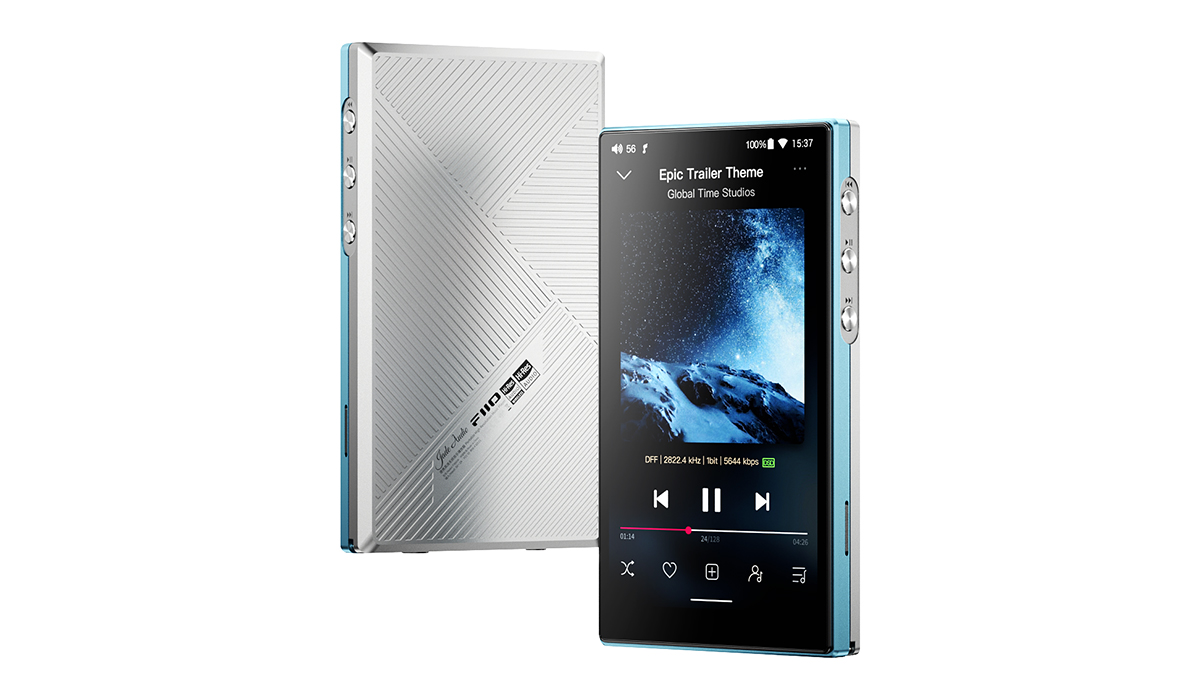 The unit itself is compact and lightweight, measuring approximately 120 x 68 x 13 mm and weighing 156 g, while the chassis combines aluminium and patterned plastic, with touchscreen that is bright and responsive. It comes with a protective cover for the DAP itself, but not the screen, so possibly look into that.
Now, it’s going to take at least one rugby field’s length to explain all the features the JM21 has (some that are seriously important, and others that are…well…’different’, such as the function to make it look like a cassette tape playing). I have to say that sometimes these novelty options detract from what the product actually has to offer, which is a pity.
Especially when this is what is on offer: The JM21’s processor is the Qualcomm Snapdragon 680 (clock frequencies up to 2.4 GHz), three Gain levels, three Volume curves, independent power supplies for digital and analogue sections, Android 13 OS, 12.5 hours of battery life (obviously dependent on usage).
Where wireless connectivity is concerned, the JM21 is both a Bluetooth transmitter and receiver. When transmitting to headphones or wireless speakers, the Bluetooth 5.0 is compatible with SBC, AAC, aptX HD, LDAC and LHDC codecs. If used as a receiver, it can deal with SBC, AAC and LDAC. Dual-band Wi-Fi is on board, of course, and the JM21 is DLNA compatible and supports Apple AirPlay, too.
Eish.
But let’s continue: The JM21’s asynchronous USB DAC supports up to 384 kHz/32-bit sampling rates. Outputs include Analogue (3.5 mm and 4.4 mm for headphones). The 3.5 mm socket can be used as an SPDIF output for use with an external DAC.
Digital is SPDIF to connect to external DACs. Physical controls include power, volume, and playback buttons, along with a microSD slot for storage expansion up to 2 TB (there is a newer JM21 version with expanded memory options).
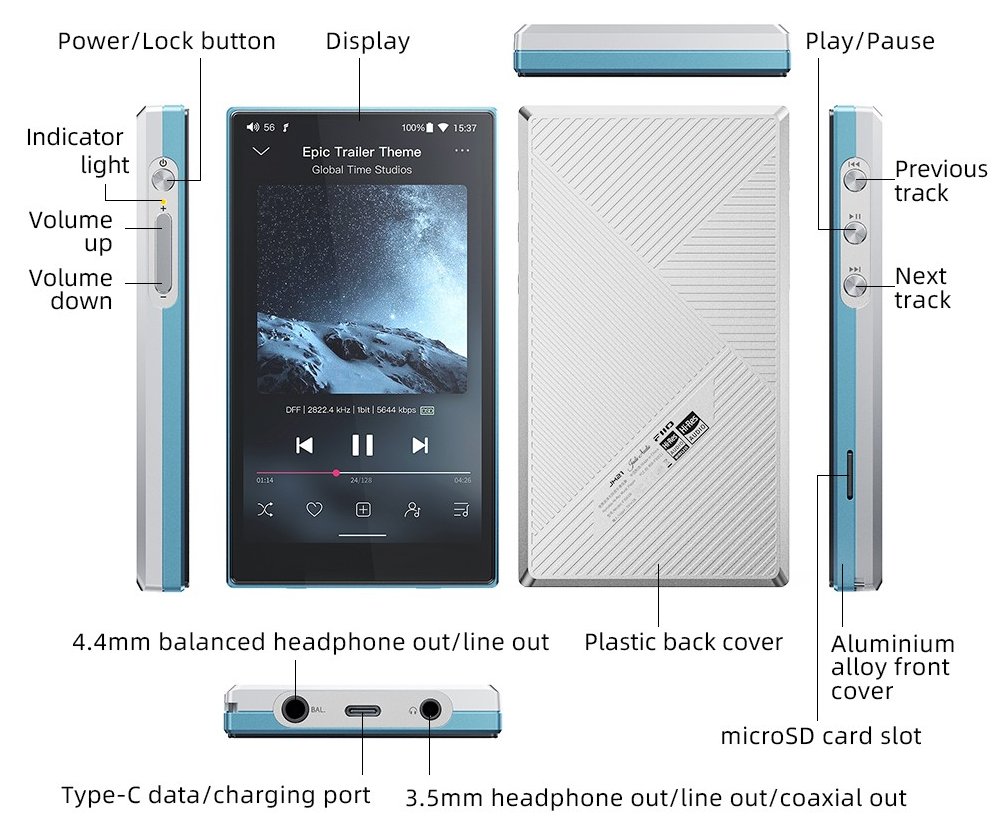
The DAP also offers six built-in modes, including Pure Music mode for high-res playback, and provides up to 700 mW of balanced output, suitable for IEMs and moderately demanding headphones. A note here: On all FiiO portable DACs/Amplifiers, I have always used over ear headphones, and have never felt they were under-powered.
So now you hopefully understand why I said earlier that even why the JM21 is considered ‘entry-level’, its abilities definitely indicate otherwise!
A word of warning here.
The first JM21 sold had storage of 3 G+32 G ROM. There were complaints that this wasn’t sufficient, so a newer version available here offers to 4 GB RAM + 64 GB ROM. Battery capacity has also been upgraded to 3 100 mAh, extending single-ended playback to 16 hours, and balanced playback to 12.5 hours.
I have the first JM21, which comes with the option of using a MicroSD card that supports up to 2 TB of info. I know that I’ve read about people out there, real or imagined, who are determined for some strange reason to download the entire Internet… But for us ‘normal-ish’ lot who aren’t trying to break ridiculous records, I honestly think what the initial JM21 offers is more than enough.
The DAP has a few more tricks under its sleeve, but I really need to get onto my experience of using it before this review gets any longer with just its abilities being talked about. For a full break-down, visit the FiiO website here: Guangzhou Feiao Electronic Technology Co., Ltd.-JM21
For the review, my headphones used were the Sennheiser HD200 PROs, the AKG K240 Mk II and the Sonos Ace – wired as well as wireless. I connected the JM21 to the awesome PSB Alpha IQs via Bluetooth. I also managed, quite by accident, to connect it to a Bluesound product, but more on that in a while. TIDAL and Spotify were downloaded, and off we went.
First off, this is a beast when it comes to power. The AKGs are more demanding than the Sennheisers and their bass is prone to overwhelming the midrange frequencies in particular, if not properly driven. Not so here – the JM21 controlled them effortlessly, keeping the bass punchy where needed and incredibly low as the cello demands on Agnes Obel’s The Curse.
On the opposite side are the Sennheisers. I love them for their clarity, but when coupled with certain players, they can sound overly clinical and especially with treble, overly bright. The JM21 doesn’t put a foot wrong here either, and while the high notes are crystal-clear, they are never jarring or borderline painful.
You know, that level of treble that makes the fillings in your teeth vibrate.
Soundstage presentation is absolutely impeccable, and on one of those rare listening sessions where I can put my feet up and not worry about an unexpected body slam from my six-year old, on good recordings of stage shows you can actually place the various instruments where they’d likely be if you could be there in person. It’s truly expansive on certain recordings.
A track I’d have loved to use here is a version of Mike Oldfield’s Tubular Bells. I had it on CD as well as DVD, where a ‘narrator’ introduces the various instruments as they are brought into the build up to the crescendo. Alas, I’ve yet to find it on either Spotify or TIDAL.
Please drop me a line if you know where it is?
In any event, yes, those dual Cirrus Logic CS43198 DACs perform admirably, and in FiiO’s own words, they have – based on previous product development and experience gained therefrom, “further optimised the segmented power supply as well as the front and rear stage gain stages for wider dynamic range and enriched musicality.”

I couldn’t agree more. But if you need a bit of a nudge to decide whether or not the JM21 is truly a performer of note, take a listen to the pre-loaded track Epic Trailer Theme (2 822.4 kHz/1-bit/5 644 kbps).
Wirelessly, Bluetooth connectivity worked faultlessly, and I was able to stream effortlessly to my PSB Alpha IQ powered loudspeakers. Honestly, no discernible degradation in music quality.
I then connected my SONOS Ace headphones via Bluetooth, and found the JM21 choosing aptX Lossless (Snapdragon Sound). After the recent release of a number of new FiiO products featuring Sony’s LDAC codec, buyers need to remember that unless you have an LDAC-compatible set of headphones or speakers, you’re not going to be able to experience what LDAC has to offer. None of my Bluetooth headphones unfortunately have the LDAC codec.
For reference, aptX Lossless is an extension of aptX Adaptive, capable of delivering bit-perfect 16-bit/44.1 kHz audio when conditions allow, with a maximum bitrate of around 1 200 kbps. LDAC, on the other hand, supports 24-bit/96 kHz high-resolution audio with three fixed bitrates: 330 kbps, 660 kbps, and 990 kbps.
If you visit the Sony webpage: Sony Corporation – LDAC™ developer site | Uncompromising wireless listening technology from Sony. LDAC provides music experiences with supreme sound quality., you can find a list of compatible products here.
My ears have endured quite a bit of abuse over the years, so in all honesty I doubt I could detect any significant difference between the two codecs, but there’s no doubt whatsoever that on headphones, at least, there’s a marked difference between them and the entry-level codecs you have to use on your Smartphone.
Whatever the case, I lined up a few tracks I know extremely well, and which have complicated, multi-layered instrumental sections or demanding vocals. Tracks such as Hurts’ Wonderful Life, Woodkid’s Run Boy Run and Loren Allred’s Never Enough.
All were rendered wonderfully, and I was hard-pressed to find fault with the JM21’s performance.
While playing around with the JM21, I encountered something unexpected. During a listening session with TIDAL, I pressed an icon on the screen out of curiosity and discovered that I could connect directly to my Bluesound ICON without needing to open the Bluesound App, while using my home network. It was a nice discovery, adding to the device’s already substantial versatility.
The one and only gripe I have is the lack of MQA, which is included on the DAP models above the JM21. FiiO has always been a firm supporter of the MQA codec, and as a supporter of it myself, had it been included on the JM21, it would have made the DAP (in my opinion at least!) 100% perfect. It’s no train smash, though, as I have several other players that support the codec.
But, still, it’s always nice to have a genuine ‘all-in-one’ device, and even with a 99% score, the JM21 is a phenomenal DAP that will attract many fans. Well done yet again, FiiO.
Andrew Rowland
Categories
Latest News
Sennheiser MOMENTUM True Wireless 5
The little things in life — like these high-fidelity in-ears — can be a revelation. You feel it every time you wear [...]