VITAL STATS
| Silver Cherub | Holy Grail | Hail Mary | |
| Cable Type | Interconnect | Speaker Cable | Shielded USB |
| Length | 1.0m | 2.0m | 1.0m |
| Directional | Yes | Yes | Yes |
| Conductors | Silver | OFC copper | Silver plated OFC |
| Resistance | N/S | N/S | N/S |
| Capacitance | N/S | N/S | N/S |
| Insulation |
Basalt fibre outer, PVC outer, mineral crystals | Basalt fibre outer, PVC outer, mineral crystals | Basalt fibre outer, silver plated outer, PVC outer, mineral crystals |
| Dimensions | N/S | N/S | N/S |
PRICE Holy Grail Speaker Cables – R18,000 per m pair, Silver Cherub Interconnects – R19,000 per m pair, Hail Mary USB – R29,000 1m cable
SUPPLIED BY Alchemist Wires / 082 841 8345 / info@alchemistwires.com
WEBSITE www.alchemistwires.com
Those that follow me know that I hate reviewing cables. It takes a long time to pick up cabling differences, and then an even longer time to determine whether these are improvements and if so, where these improvements show up most prominently within the audible environment.
Consequently I take a pragmatic approach. Whilst there are numerous examples online of people offering significant financial incentives for those who can determine differences in blind listening tests between cables, much less between mud and bananas used as conductor, my approach is to listen over time and let my brain decipher what it hears. Dangerous territory in other words.
In my experience cables can only detract from audio system performance. In other words they cannot add to a source but can only distort or induce distortions to that source in much the same way as we have amplifiers and pre amplifiers presented with a signal. They can only work with what they are given but have the potential to introduce what isn’t originally part of that signal.
Personally I have always had a preference for silver over copper purely because my engineering brain is cognitively biased towards the superior conductivity of silver and using silver plated OFC or solid silver thus makes sense to me. But as I say, it is over time and bedding down with a system that when I change cables that I start to notice changes. These changes are almost always subtle and revolve mostly around space, spark and sizzle – the triple S as I call it. Good cables will deliver more in the sense of detail, which will have a knock on in improved space, better dynamics (quiet to loud transitions and back again) and better presentation of immediacy in music.
Critical listening in A/B switched situations in theory makes things easier. However, when stacked up and analysed with statistical methodologies it becomes much harder because over time what happens is that we’re fighting physiology. Your brain does a wonderful job of filling in blanks over time and the longer you listen the better at it your brain becomes (your eyes do the same thing).
Hence short bursts of listening I have found personally to be of value in helping me pick up cabling differences and in the case of the Alchemist Wires in play in this review this is what I did. I swapped them for my Tributaries several times, leaving them alternately in play for the next listening session. At this stage I didn’t have the USB cable in play – I typically run direct from source (Node as a streamer DAC) direct to amps and then speakers. Adding an external DAC connected to the Node via USB came later…
In terms of the pairing of the Alchemist Holy Grail speaker cables and Silver Cherub interconnects as a pair against the Tributaries was a deliberate choice. I wanted maximum impact from the unique cable construction deployed by Alchemist wires where a tremendous level of attention has been placed on shielding. The cabling all runs in the middle of a mineral crystal (they don’t say what but I assume it’s crushed diamond at the price) jacket that allegedly shields the cable from any and all external sources of signal contamination. In today’s world of RF interference coming from everywhere – every electronic device and heavens knows what in our power supplies and cell phone masts signal contamination from such sources cannot be ruled out as potential colouring influences on our sound.

These may be small but remember they can and are amplified at every stage. Small changes and influencers can thus compound, especially at the source. Remember this part.
The speaker cables themselves are sturdy thick affairs with a light khaki brown outside basalt fibre sleeve lending a sense of class to the cables as they do across the range. These are not cheap cables and hence one would expect premium quality throughout! I have to comment that at the price I might have been happier with a sense that the actual copper wires were thicker than they appear to be when they pop out on either end for attaching speaker to amplifier. This set were fitted with compression bananas that fit snugly and ensure a tight connection either end and you need to take care when withdrawing them such as to not cause damage. In my mind you can’t go thick enough when it comes to the core copper but it goes to show how perception (mine) can colour reality.
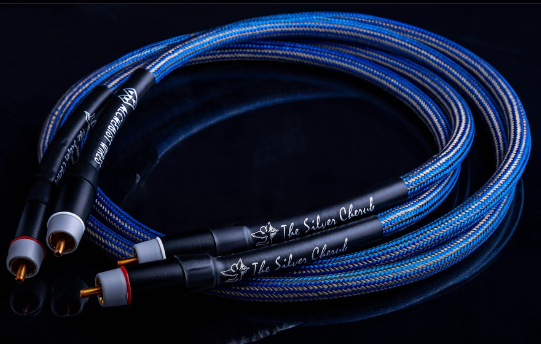
The same look and feel to the interconnects is carried by the outer sleeve once again but in an understated blue this time. The RCA plugs are easy to attach but still grippy with a great balance between usability and attachment. My Tributaries come with WCB clamping type RCAs which certainly bite harder but which come with their own issues of attaching them (not always easy given their size). At this pricing point and high end level however I would imagine balanced cables to be the norm…
Handling these cables is a pleasure. I expected more weight but was pleasantly surprised that they don’t weigh two tons a side which is a good thing in being kinder to the components they’re attaching to. They are decently flexible given the diameters, and there is no crunchy feel to the mineral crystals complex that comprised what I imagine to be the bulk of the cable construction. I’m not sure why I was expecting a crunch, but as one should never bend cables excessively I didn’t attempt a 90 degree bend ‘just to see’! The cables flex, but they won’t allow you a super tight radius when bending.
And how did they sound?
In my system what I heard is what I think can be attributed to a lower noise floor. In other words that crystal mineral shield works and I think it does so by insulating any outside noise from entering the audio loop between components. In my system a lower noise floor is not the absence of hiss as we had in the old days with Dolby NR (noise reduction) switching on our tapes. It is less interference of background white noise, and other, that gets into the audio circuits via sources diverse and numerous. These cables won’t remove noise that’s already there but they will certainly ensure no more new noise is added in their portion of the role of signal transmission.
The differences are subtle, as expected. And over several days of diligent fresh listening although I’d not want to put my head on the proverbial block the system had more in dynamic response, a larger and more open sound stage thanks to transients that seemed to hold their decay a fraction longer. I got bigger venues from my music in other words and that’s no mean feat because staging and believability is always the holy grail we’re chasing in our hobby.
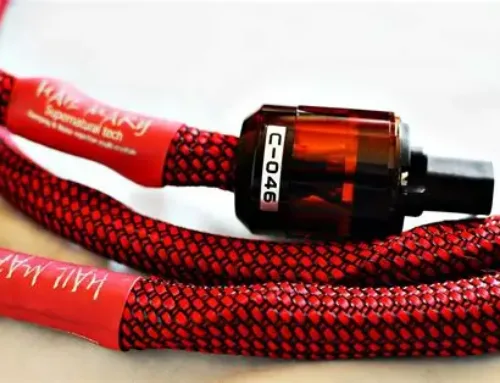
But then we get to this Hail Mary USB cable. You thought I’d forgotten.
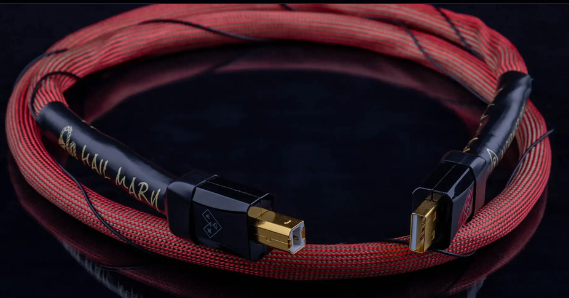 As I generally don’t use USB for data transmission I had to find a standard cable – and I found one in my cable collection nothing more than a simple patch cable.
We (I had Joel over for a listening session seeing as how he’d lent me the DAC to begin with it seemed appropriate) started with using this standard USB cable from source to DAC and then from DAC to Amps. There is a marginal difference in the NuPrime DAC over the Node’s internal DAC which is a different topic for a different day. What is happening is ones and zeroes now stream from the Node to the DAC. Standard digital signal stuff.
Listening to a reference track I got a sense of what was happening sonically and then we swapped over to the Hail Mary USB cable. Which is where all hell broke loose.
Literally within the first ten seconds of listening I asked for the cable to be changed back. And then back again. It is the first time, hand on heart, that I have heard a stark improvement immediately off the bat from a cable. That this is a data only cable makes it even worse with my only explanation being that a lower noise floor owing to interference being transmitted in the standard patch cable being picked up and injected into the signal path somewhere.
In a blind listening test (I know when I can’t be trusted with my own ears) we ended 7:0 in people picking the Hail Mary over the standard patch cable. No prompting, swapping the start cable across all 7 and after one listen of each cable across one track and then asking them to pick A or B. I’d love to further verify this against 100 people at a show one day because it blew my mind that I heard it, immediately and that clearly.
Let me be clear. We are talking about subtleties. This is not smash you in the face with a gold brick chalk and cheese as obvious as a Dolby NR button being turned on and off. But an audible improvement that can be heard consistently like this is notable and important. It goes to show that signal transmission matters, and signal integrity in that transmission matters. That there is an immediate audible difference discernable, and more importantly that the audibility is an improvement is important. That this happens across a pure data stream of one and zeroes is telling.
My conclusion as stated is that the cable has a lower noise floor, with less carry from externally introduced interference (such as RF for example) with the small influences that these carry being eliminated and hence not amplified across the signal chain by the time we get signal to speakers. This is carried across the range and as much as I hate to admit to falling for snake oil salesmen selling mineral crystals as an insulation against interference in the signal paths of our music, the evidence is overwhelming.
It works. And it is better.
William Kelly
ALCHEMIST CABLES – SECOND OPINION:
After having a good look and listen to Alchemist Cable’s Hail Mary USB cable, I was given an opportunity to have a quick listen to some of the company’s other cables before sending them off to William Kelly, for him to give them a more in-depth review.
The cables in question were the Silver Cherub interconnect and Holy Grail speaker cables.
In common with the Hail Mary, both the interconnect and loudspeaker cables were well packed and looked and felt like quality audio components. Again, in common with the USB cable, both cables used mineral crystals in their sheathing to reject RFI interference and damp out vibrations that might affect cable performance.
I first used the Silver Cherub between a DAC and my amplifier, and once I had come to grips with what the cable brought to my system, I added the Holy Grail speaker cables. These replaced the highly regarded speaker cables I was using at the time (there are usually two or three sets of speaker cables that live behind my speakers, and I tend to swap these out reasonably often).
As I stated in my Hail Mary review, I don’t believe that there will be “massive” differences between competently designed audio cables. Differences, yes, slight improvements, yes. And this is pretty much what I heard with the Alchemist Cables in my system. Subtle, yet audible and repeatable differences.
What was interesting to me was that I certainly did detect a familial sound signature between the digital USB cable and the analogue interconnect and speaker cables.
After letting the Silver Cherub run for a few hours, I sat down to have a good listen. And what I heard led to the comment made above about there being a familial sound to the cables. The Cherub added a subtle sense of depth to music and the background was a little quieter.
When I put the Holy Grail speaker cables into my system, again I heard those familial-type differences. There was more detail and pace to music, and the overall soundstage was more palpable and defined.
Importantly, none of the cables I compared the Alchemist Cables to, were exactly entry-level and all were most certainly fit for purpose.
That I heard a difference, and importantly, liked what I heard, means that I liked the Alchemist Cables.
Joel Kopping
Categories
Latest News

Alchemist Wires: Hail Mary Shielded USB Cable
VITAL STATS Cable Type Shielded USB Length 1.0 m Directional Yes Conductors Silver plated OFC Resistance N/S Insulation Basalt fibre [...]