VITAL STATS
| Cable Type | Shielded USB |
| Length | 1.0 m |
| Directional | Yes |
| Conductors | Silver plated OFC |
| Resistance | N/S |
| Insulation | Basalt fibre outer, silver plated outer, PVC outer, mineral crystals |
PRICE Hail Mary USB – R29,000 (1m cable)
SUPPLIED BY Alchemist Wires / 082 841-8345 / info@alchemistwires.com
WEBSITE www.alchemistwires.com
What’s in a name? Or perhaps more specifically, what’s in the promise of a name?
I ask this, because when you call your company Alchemist Wires, you hint at the possibility that your cables can do something extra. Something that other “mere” cables cannot do.
In the case of the Alchemist Wires Hail Mary USB cable reviewed here, you’re perhaps suggesting that this cable can do more than simply transmit digital data as accurately as possible. After all, in the digital domain, data is either there or it isn’t.
If data is there, you hear music. If it isn’t, you don’t. Full Stop. End of discussion.
Except…
I heard more than a subtle difference when swapping out USB cables in my system.
When similar USB cable comparisons were done on various other audio systems (more on these in a short while) similar and even bigger differences were heard compared to those I heard on my system.
Taking a leap back — and I would like to point out that my opinion on cables has mellowed over the years — while I still believe that cables can make a difference in a system, the operative word is can and not will make a difference. Further to this is my belief that if a cable makes a “radical” difference in a system, either it, or the cable it replaced, was not fit for purpose.
What do I mean by this?
Here’s a simple example. If I use a crappy RCA cable – that I got for free with a DVD player 25 years ago – as a digital connection between a streamer and a DAC and then compare this to a dedicated, Uber expensive, 75 Ohm cable designed to transfer digital data, I would expect to hear a difference. Is this difference due to the greatness of the expensive cable, or the fact that the cheap RCA was not designed for data?
I believe the latter is true.
The question now is, if I used two decent quality USB cables in my home system to compare the Hail Mary cable against, both of which were:
A: designed to transfer digital data, as USB cables are, and
B: Both had factory-fitted ferrite cores attached that should stop the cables from acting as antennas and which, in theory, should also filter out any noise that was picked up by the cable.
These cables were therefore, by my own definition, fit for purpose. And so why should I, my daughter and colleagues (and even strangers to our esoteric world of audio), hear a positive difference between them?
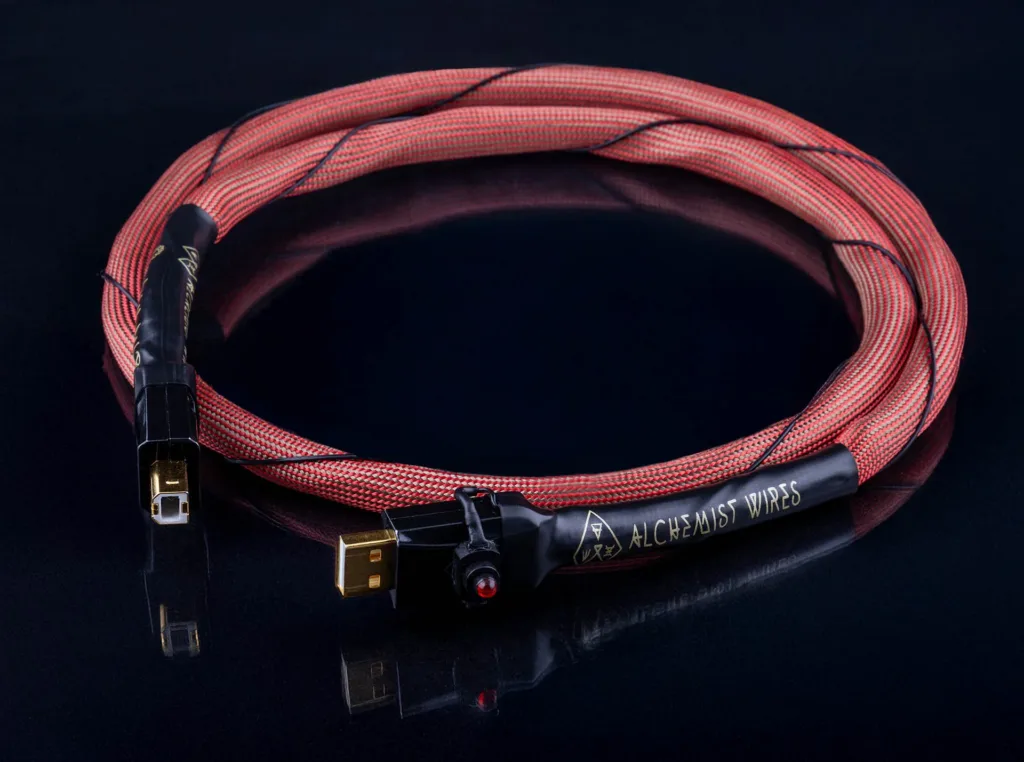
This now brings me back to the Hail Mary, which apart from looking exceptional for a cable, is really well made. Its connectors were gold-plated and fitted more solidly than standard connectors for computers, streamers and DACs.
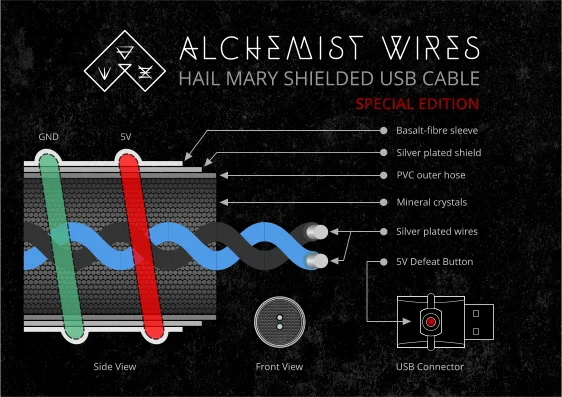
Other visible signs that the Hail Mary was a step or three above average was the external 5 volt power cable, wrapped in a spiral around the main, basalt fibre sleeved main conduit.
Internally though, is where the real art, science, or magic happens.
Here there are silver-plated pairs for data, while the cables are surrounded by a secret blend of mineral crystals that, according to the Hail Mary’s manufacturer, do two things. Firstly, the crystals are said to reject RF and other types of airborne noise (which the ferrite cores of my standard cables are also supposed to do). Secondly, the tightly packed crystal matrix is said to damp any vibrations from affecting the data transmission wires.
Using RFI reduction devices is not new to me and I in fact use some prototype RFI filters in my system (before anyone asks, they’re there as I hear a difference when I use them).
At this point, and since I’ve already stated that I believe that RFI filtration makes a difference, I offer naysayers the opportunity to stop reading right here, to go off and shake your collective heads at the insanity of me believing that such stupidity exists — particularly in the digital domain — and to go play a game of, “How stupid can he be?” amongst yourselves.
Those who remain can read on and see how my listening and evaluation process proceeded.
The process involved no less than three systems and a handful of both audiophile and decidedly non-audiophile people, and took place over a few weeks.
As per usual, I started with my system and here the Hail Mary was used between my laptop and my NuPrime DAC. 90 percent of my listening was done using music ripped to my laptop. This, as I did not want there to be any possibility that differences I would possibly hear, were due to the cables or the vagaries of our internet and streaming services.
Cable evaluation was a simple and straight forward process.
Step 1: Listen to some music that I know well using my standard, non RFI filter-attached USB cable.
Step 2: Replace the cable with my RFI filter-attached cable and listen again.
Step 3: Fit the Hail Mary and listen again.
Step 4: Rinse and repeat.
My impression was that as cable quality and filtration improved, the system was allowed to breathe better, and music flowed with an ease that was audible.
System background noise or blackness diminished and there was more definition and space to music. There were clearly audible differences between each step up the cable rung.
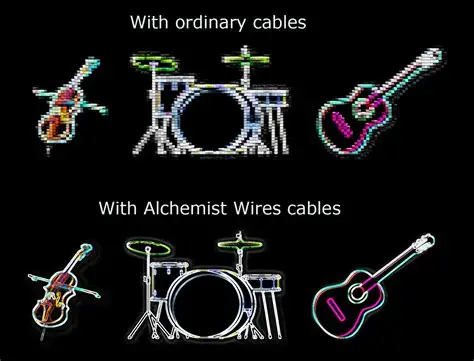
On a Fiona Apple track that my daughter played, she described what she heard as if it was almost like the vocalist had stepped closer to the microphone and her vocals became more distinct and textured. On the standard cable, the track simply lost much of its drive and presence.
My music selection for the review ran the gamut from Jazz, Rock, Pop, Metal, Classical and Blues, as well as from so-called audiophile recordings to mass market ones. The improvements, while not quite as present on lesser quality and more raucous recordings, were nonetheless always there.
As far as I know, no data bits got lost along the way between laptop and DAC using any of the cables. There were no noises akin to data loss using any of the cables. So to my mind, the improvements heard had to be due to improved construction and RFI filtration and damping.
That was the end of part one of my review.
For part two, I took the Hail Mary past a friend who has one of the best sounding systems I’ve heard recently.
All he was asked was if he used USB in his system. He wasn’t told what cable I had or why.
He didn’t use USB cables in his primary system but he did use it in his smaller system. Despite being the smaller of his systems, the “baby” system was still truly high-end and consisted of a Raspberry Pi with dedicated software, used as Roon end point. From the Pi, a USB cable runs to the system DAC/Pre. From there to its power amp and speakers. A simple system, but still one worth north of $20 000.00
We first listened to the main rig, which as stated is superb. Then we listened to the smaller rig and this (apart from not playing as low, which was understandable considering the speaker size difference), this system didn’t quite have the pace or finesse, or detail of the big rig. It was still superb by normal standards, but not that close to the big rig.
We then replaced the USB cable that was in use with the Hail Mary.
In high-end audio terms, the difference was far more noticeable than I expected. The smaller system now sounded far similar to the big rig. The lineage between them – both were from the same manufacturer – was far clearer. The big rig was certainly better, but the difference was smaller. As with my system, the Hail Mary improved definition, detail and staging.
Part three of my cable review took place at the home of editor in chief, head bottle washer and turntable cynic extraordinaire Mr, Dr, Prof William Kelly. The latter two titles were bestowed on him by me.
Also present on this day were some audiophile friends and colleagues as well as some real people in the form of William’s family (as in non-audiophiles).
As was possibly to be expected, all audiophiles heard differences between the lesser and better cables, and these differences correlated with what I’ve said above, so I won’t waste space repeating what the audiophool people had to say.
What I do want to add was that three non audiophiles were asked to have a listen. None were told what cable was going to be changed, only that one would be changed. They were asked to simply state if they preferred the sound with cable one or two. All chose the Hail Mary.
Before finishing I should mention that at William’s place, one of our friends brought along his custom made, pure silver conductored USB cable. This cable had separate connections for power and data.
The relevance here was that there was no power connection between source and DAC, and therefore one less path for noise to transition between devices.
When comparisons were made between this cable and the Hail Mary, it was clear to us that both cables were way better than a standard USB cable. In fact in some areas the pure Silver and separately powered cable could even have edged out the Hail Mary. However, what it highlighted was that despite what most people think, there is far more to USB cables and music playback than simple data transmission.
Better shielding, better connectors, better damping and better noise rejection all play a part in what we hear. Clearly taking power out of a USB cable also makes a sonic difference, and I happen to know that the Hail Mary’s designer has this addressed in some of his other USB cables.
The only area I haven’t spoken about is value and this is simply because the Hail Mary is not an inexpensive cable. While I can state quite clearly that sonically, there are very few cables that I’ve ever heard that have made as much difference in my and other systems as the Hail Mary, there will always be those who look only at price. All I can say here is that if you use USB and you want to get the most out of your system, you need to try a Hail Mary and decide on its ultimate sonic value for yourself. I know where I stand on this.
Joel Kopping
Categories
Latest News
TWO NEW REASONS TO LISTEN
Introducing the NAD C 359S and C 569 The NAD Classic Series welcomes two new additions: the C 359S Integrated [...]