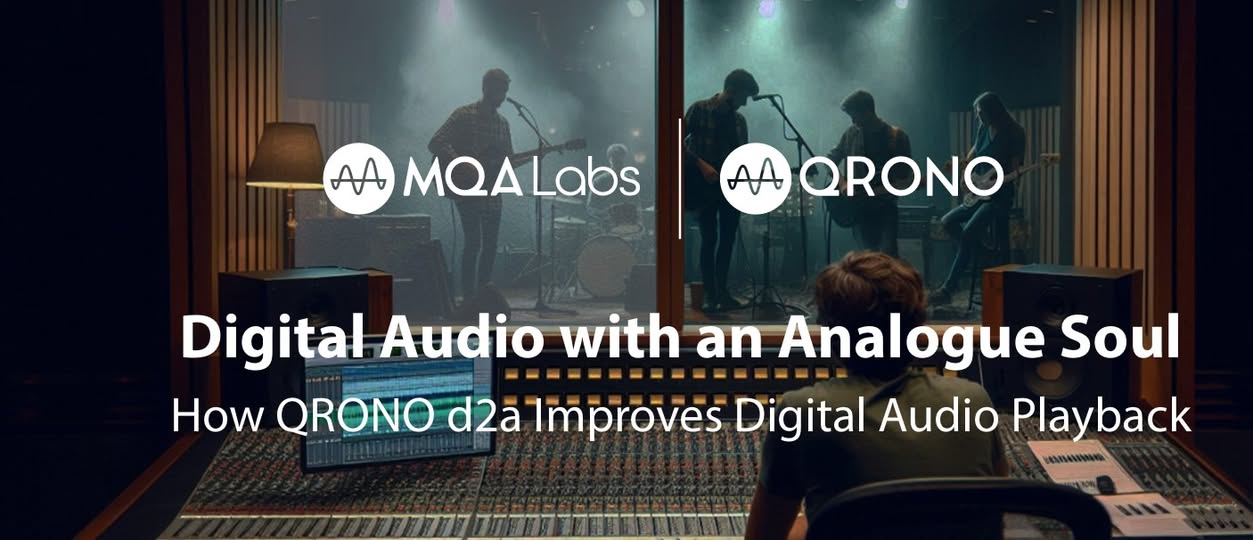
After rereading the QRONO whitepaper, what strikes me most is that QRONO d2a is much more than another selectable “DAC filter.”
It is a different reconstruction philosophy.
Most modern DAC chips upsample every incoming PCM signal before feeding their high-speed modulators. Their filters are usually designed to maximise conventional specifications: a flat passband, strong suppression of ultrasonic images, low noise and impressive distortion figures.
But this can come at a cost in the time domain. A conventional linear-phase filter spreads the energy of a transient both after and, unnaturally, before the event. Even many minimum-phase filters continue ringing longer than necessary, allowing closely spaced musical events to blur into one another.QRONO starts with a different question: how can we control imaging while preserving the timing of actual music?
Instead of applying essentially the same generic filter to every input rate, QRONO uses filters optimised for the musical spectrum and for each individual sample rate. A 44.1 or 48 kHz signal therefore receives a different reconstruction treatment from an 88.2, 96 or 192 kHz signal. QRONO can replace external upsampling filters, work together with the filters inside the DAC chip, or in some cases be programmed directly into that chip.
Crucially, every implementation is tuned to the specific DAC architecture used in that product. Noise shaping is then employed to manage remaining low-level ultrasonic imaging and help the converter operate within its most linear range.
The measurements in the whitepaper are striking. In the tested product, the 48 kHz QRONO response was about twice as compact as the DAC’s existing minimum-phase filter. At 192 kHz, QRONO’s time response was reported to be around twenty times more compact. These figures apply to that particular implementation, but they clearly illustrate what the technology is designed to achieve.
Perhaps the most important point for MQA enthusiasts is this: QRONO does not require an MQA-encoded file, folding or unfolding. It operates at the playback side and can benefit ordinary PCM, including CD-quality material as well as high-resolution audio.
It does not repair temporal blur already embedded during recording—that requires source-side technologies such as FOQUS or appropriate studio processing. But it can prevent the DAC from adding another unnecessary layer of blur.
To me, QRONO is one of the clearest examples of how MQA Labs is carrying the original time-domain thinking forward in a more open form. It is not primarily about producing larger sample-rate numbers. It is about doing less damage when digital samples are reconstructed into analogue music.
The MQA DNA remains—but the idea is no longer confined to the MQA format.
Peter Veth, MQA Experience Group
Categories
Latest News
Apple Music Now Available on Bluesound!
Apple Music subscribers can now listen to over 100 million songs, ad-free, on Bluesound wireless speakers, stereo components, and soundbars [...]