| DAC | CS43198 |
| Max Output power (3.5 mm) | 310 mW (16 Ω,THD+N<1%.USB IN) |
| Max Output Power (4.4 mm) | 650 mW (32Ω,THD+N<1%,USB IN) |
| Frequency Response (both) | 20Hz~ 20Khz, curve amplitude change ≤ 0.1dB |
| Maximum supported sampling rate | 384 kHz/32-bit (USB, COAX) |
| Volume control | Analogue Potentiometer (ADC Sampling) |
| Size | 60.5 x 105.7 x 16 mm |
| Weight | 150 g (main machine) |
PRICE R2 890
IMPORTED BY C-Plan Audio 083 212-4599
WEBSITE www.cplanaudio.co.za / www.fiio.com

The Short Of It…
FiiO has done it again. Just when I thought I’d reviewed enough of the company’s portable DACs to not be surprised at anything new, along comes the Q11. Can’t remember ever having had my headphones experience such a work-out. Truly impressive performance.
The Long Of It…
So, let’s get the technical stuff out the way, so we can get onto the actual review.
The Q11 is primarily designed to be bundled with the majority of Smartphones on the market today. It comes bundled with a silicone bundle kit and suitably short connecting USB-Type C connecting cable to ensure maximum size compatibility.
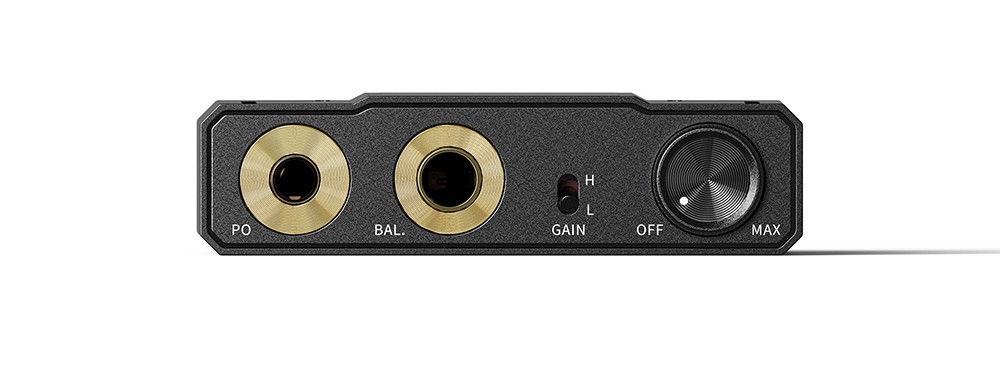
With a 4.4 mm balanced output of up to 650 mW, as well as a 3.5 mm single-ended output (3.5 mm output also supports coaxial output), the DAC is easy to listen with low and high-impedance headphones.
Battery life is around 13 hours.
The Q11 supports UAC1.0 and UAC2.0 modes (switched via the App). In UAC1.) mode, the Q11 can be connected to devices like the Switch/PS5, allowing you to immerse yourself in gaming sessions.
Audio quality is taken care of via a high performance CS43198 DAC, dual op-amps, high precision crystals and a low noise power supply.
The volume knob is solid and gives you good control, also acting as the On/Off switch.
 As always, the FiiO App, which is available for both Android as well iOS devices, will give you myriad tweaking options. The app allows users to customise general functions such as charging on-off, RGB indicator light on-off, in-vehicle mode, DAC work mode, and more.
It also enables adjustments to the equalizer and audio settings like digital filter, channel balance, and others. In general, I usually listen to the FiiOs without any fiddling, but it’s nevertheless a nice-to-have.
Now, the moment the Q11 came into my sight, I just knew I was in for a treat.
Its form is immediately reminiscent of my first ever FiiO portable DAC, the BTR1, and I have such fond memories of that unit, that the moment I see a similar build, I’m sold. Yes, of course that’s hugely unprofessional sounding, but when it comes to FiiO, my first impressions have never let me down. And never has FiiO!
The Q11 is stunningly machined in a metal jacket that gives you an extra sense of holding something solid. There is a glass ‘window’ that serves two purposes –  one, to give you a peak at the Q11’s internals, and two to give you a visual indicator of what music files you are listening to: Light blue (PCM 48 kHz or below), Yellow (Above 48 kHz), and green, DSD.
Now, I own the Q3, stunning piece of equipment, and on those rare occasions when I actually can kick back on the couch and relax, it’s my go-to portable DAC/Headphone Amplifier. Its form is quietly elegant, understated, even. But you nonetheless know that it’s a quality piece of kit.
However, when you first see the Q11, it shouts, “HOWZIT, BRU!” (apologies, only South Africans will get that). Point is, the Q11 isn’t subtle. Everything about it yells that it’s a no-nonsense powerhouse that’s going to handle anything you decide to throw at it.
And boy, did it.
My Sennheisers are the most clinical headphones I own, but this was the first time in many, many hundreds of hours of listening on other portable DACs, that a bit of that sterility was taken hold of, slapped around a bit, and handed back to me with noticeable more punch in the midrange, in particular.

Yes, yes, not everyone will like that approach, but I suspect it’ll mostly be those who focus so much on trying to find the most accurate reproduction of a live performance…that they’ve forgotten how to just sit back and enjoy music. It doesn’t have to be perfect, it just needs to make you enjoy it.
On the other side of the spectrum, my AKGs can be overly bass-heavy with a lesser controlled DAC/Amp, muddying the midrange in particular. Not so here: again, the Q11 was able to control the bass-heavy tendencies, tighten everything up, and keep the lower frequencies in particular, firmly under control.
I have to say that I was so taken with the Q11’s look initially, that I was planning on selling my Q3 so that I could buy this beast instead. Then I saw mention of the fact that the Q11 was regarded as ‘inferior’ by several reviewers to the Q3 because it lacked MQA-decoding.
Now, I’m a self-confessed MQA Fanboi. My reference desktop streamer is the award-winning Bluesound NODE ICON, which is obviously MQA-capable. But of late I’ve become somewhat tired of having to search through TIDAL to find the MQA files, and when I do find them, it’s not always a track or artist I like. So, it’s become a bit of a mission, and at the end of day, and that’s not what listening should be about. To be honest, 32-bit / 384 kHz, DSD256 capabilities are more than enough for me these days. However…there are rumours that Lenbrook and MQA Labs have something interesting up their sleeves with regards MQA, so let’s wait and see.
As with all my reviews, I have a set few tracks from Spotify and TIDAL that I know well enough to be able to tell if I’m missing some detail, or if I’m hearing more detail than I usually do.
 I can’t claim that the Q11 provided more detail than other portable DACs I’ve reviewed, but I certainly didn’t get the impression that anything was missing. All the detail was there; it was just a bit more in-your-face due to the added amplification.
This unexpected boost in output prompted a change in my usual test track listening, because the Q11 is a DAC/headphone amp that has such character to it, that… Well, you find yourself looking for more music to listen to than you usually do when reviewing.
So, I listened to Sarah McLachlan, Missy Higgins, Pink Floyd, Mike Oldfield, Gary Moore and more, for standard reference listening. All of them great, of course, but you kept getting the impression that the Q11 was capable of a lot more.
Challenge accepted.
Loreen with Tattoo, Mimi Webb’s Good Without, Jordan Sparks’ Battlefield, Diddy’s Coming Home, Seal’s Crazy, Woodkid’s Run Boy Run and many more. It went late into the night. The Q11 never ran out of steam, but I did, reluctantly. And thankfully I did so for the health of my ears, because the temptation was always there to try the extent of the Q11’s abilities. I suspect my ears would have come off second. Possibly third.
But now I must add a caveat about the Q11’s output. Those of us who have been in the audio industry for even just a reasonable period of time know all-too-well that ‘power’ is never a guarantee of quality. An amplifier that just takes all the frequencies it’s being fed and boosts them equally across the board is going to sound awful.
And of course, the Q11 is both a headphone amplifier and a DAC. And it’s the latter, thanks to its high-performance CS43198 chip and 384 kHz/32-bit, DSD256 sampling rates, that makes all the difference to the amplification. Yes, the output power is impressive – but it’s controlled with an iron fist. And that’s what makes the difference.
This really is a great DAC/Amp that ticks all the right boxes and gets the perfect mix of musicality and power. Highly recommended for an audition.
Andrew Rowland
Categories
Latest News
Apple Music Now Available on Bluesound!
Apple Music subscribers can now listen to over 100 million songs, ad-free, on Bluesound wireless speakers, stereo components, and soundbars [...]